

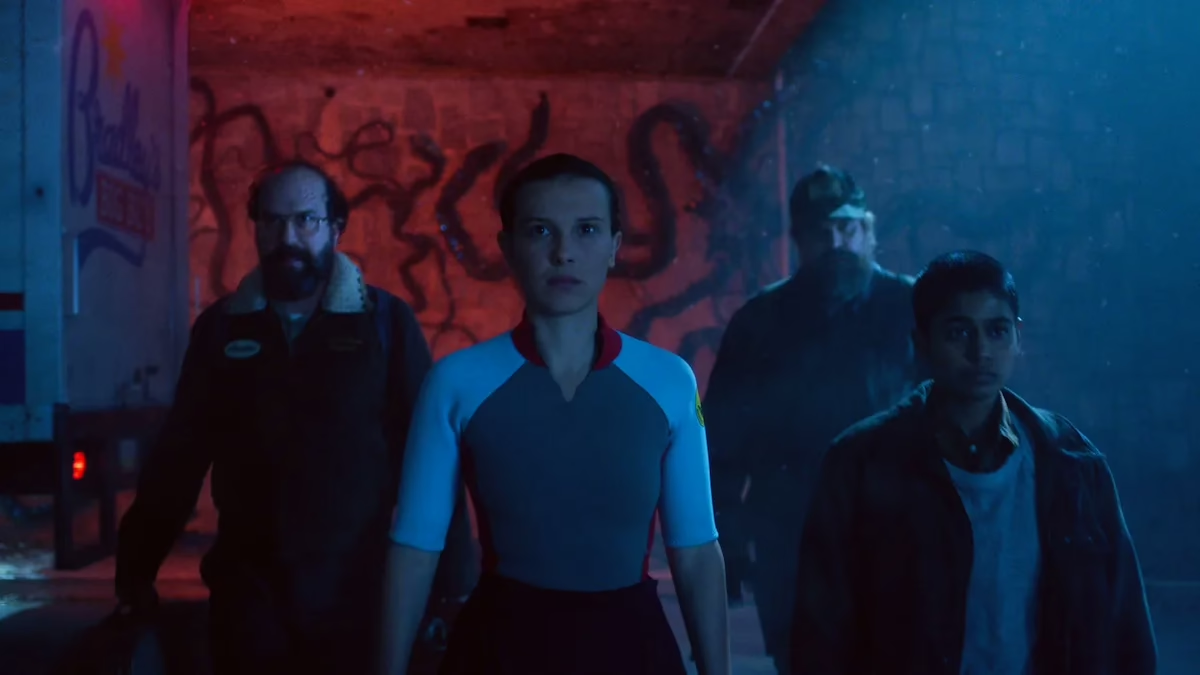
As the last episode of Stranger Things season 5 drops on Netflix, one question is dominating fan conversations in the U.S. and beyond: is this truly the end of Stranger Things, or could a season 6 still happen? Netflix and the Duffer Brothers have now drawn a clear line in the sand: the story that began in Hawkins back in 2016 reaches its definitive conclusion with the season 5 finale.
Stranger Things Ends With Season 5: What That Actually Means
Before diving into theories and wishful thinking, it’s important to clarify the official status of the show. Season 5 is not a mid-point, a soft reboot, or a simple pause. It is the planned ending of the main Stranger Things saga—the one built around Hawkins, the Upside Down, and the original core cast.
The Duffer Brothers have repeated in multiple interviews that the series was always designed with a clear endpoint. Season 5 is that endpoint. The finale doesn’t tease a direct sequel, doesn’t hold back a major cliffhanger for a hypothetical season 6, and doesn’t try to keep the main narrative open just because the show is a global hit.
A Finale Designed as a Narrative Full Stop
When viewers press play on the season 5 finale, they’re not just watching another episode—they’re watching the closing chapter of a story that began with the very first episode of Stranger Things. The creative goal was not simply to defeat one last villain, but to wrap up every major storyline that has been building over the years.
Character arcs that started when the gang was riding bikes through Hawkins and hiding from government agents are brought to a point of emotional and narrative completion. From Eleven’s journey of identity and trauma to the town’s connection to the Upside Down, the finale is structured to tie off loose ends instead of setting up a continuation.
Why the Duffers Stopped at Season 5
From a business standpoint, Netflix could easily have pushed for more seasons. But creatively, the Duffer Brothers chose a different path. They wanted to avoid the common genre-show trap where a strong concept gets stretched so far that it loses impact.
Several deliberate choices led to the decision to end with season 5:
- A story with a built-in endpoint: The main Stranger Things plot was conceived with a limited lifespan, not as an endless, open-ended universe.
- Character evolution: The kids we met in season 1 have grown up. Their personal journeys reach crucial turning points that don’t make sense to keep postponing.
- Creative integrity: Rather than dragging the show out until audiences get fatigued, the creators opted for a finale that feels earned, not forced.
In other words, the decision to stop at season 5 is a creative choice, not a cancellation. The series is ending because the story is finished—not because the show underperformed.
No Stranger Things Season 6: Netflix’s Official Position
If you’re still hoping Netflix will suddenly announce a surprise season 6, all current information points in the same direction: there is no Stranger Things season 6 in development. Season 5 is billed as the final season of the main series.
The last episode is designed to feel like closing a book, not flipping to another chapter. Central mysteries are resolved, emotional arcs are paid off, and the characters arrive at destinations that don’t call for an immediate follow-up season centered on Hawkins.
Spin-Offs and Side Projects: The Universe Lives On
While the flagship series is ending, the Stranger Things world isn’t being locked away forever. Netflix and the Duffer Brothers have confirmed that they’re actively developing spin-off and companion projects that expand the universe without undoing the finality of season 5.
These projects are meant to exist alongside the original series, not as a direct continuation of the main plot. Among the initiatives already known or discussed:
- An official stage play set within the franchise’s extended universe, exploring parts of the story from a different medium.
- Spin-off series concepts that do not rely on the original core group of characters.
- Stories set in other eras or corners of the Stranger Things world, focusing on new perspectives within the mythology of the Upside Down.
Crucially, these projects are being treated as standalone experiences. They’re designed to enrich the Stranger Things universe without reopening the closed book of the main storyline.
A Finale That Plays Like a Feature Film
In keeping with Stranger Things’ long-standing blend of TV and cinematic ambition, the season 5 finale is structured less like a standard episode and more like a full-scale movie. Longer runtime, bigger set pieces, and a focus on emotional payoff all contribute to a sense of watching a final film in a beloved franchise.
This approach serves a strategic purpose: to give fans an ending that can stand the test of time. Instead of trying to pivot toward a new plot thread or tease a reboot, the show embraces its role as a decade-defining pop culture phenomenon and leans into closure.
Rather than launching a new phase, the finale marks the end of an era—for the characters, for Netflix, and for a generation of viewers who grew up alongside the cast.
How Fans Should Think About the End of Stranger Things
For audiences in the U.S., where binge-watching and franchise-building have become the norm, it can be tempting to see any ending as temporary. But with Stranger Things, the signals are consistent: the core story is over.
That doesn’t mean the emotional connection disappears. The show is likely to remain a long-term fixture in Netflix’s catalog, and its characters and imagery will continue to shape nostalgia and genre storytelling in American pop culture. What it does mean is that future projects won’t be Stranger Things season 6 in disguise—they’ll be new stories inspired by the same universe.
What to Expect Next From the Stranger Things Universe
Looking ahead, viewers can reasonably expect more announcements around stage productions, potential spin-offs, and other narrative experiments. But based on what the creators have said, you shouldn’t expect:
- a direct sequel season picking up right where season 5 ends,
- another show built around the same ensemble of main characters as the central focus,
- a storyline that reopens the specific arc that season 5 is designed to resolve.
Instead, any new projects will likely explore fresh perspectives, timelines, or tonal shifts, harnessing the Stranger Things brand while respecting the integrity of its original conclusion.
FAQ
Does the Stranger Things season 5 finale officially end the main story?
Yes. The season 5 finale is intended to be the definitive end of the primary Stranger Things storyline centered on Hawkins, the Upside Down, and the original core cast. It’s written as a conclusion, not a transition to a season 6.
Is Netflix secretly planning a Stranger Things season 6?
Based on current information and official statements, no. Netflix and the Duffer Brothers have positioned season 5 as the final season. There are no announced plans for a season 6 that would continue the main narrative.
What kinds of Stranger Things spin-offs or side projects are being developed?
The creators have confirmed work on various derivative projects, including an official stage play and potential series set in the same universe. These spin-offs are designed as independent stories, not as a direct continuation of the events of season 5.
Could the original characters return in future Stranger Things projects?
While nothing is impossible in the long term, the current plan is for spin-offs to stand on their own, without relying on the main cast as central protagonists. Any return of familiar characters would be more likely as a limited callback or Easter egg than as a full-blown continuation of their original arcs.