
On December 11, 2025, HBO Max is rolling out Belphégor, a four-part French psychological thriller that turns one of France’s most enduring genre myths into a tense character study set inside the Louvre. Co-produced with Pathé and M6, this new take leaves behind the more traditional ghost-story imagery associated with earlier versions and leans hard into paranoia, memory loss, and the eerie power of an ancient artifact.
Why HBO Max Is Betting on a Modern Belphégor
For U.S. viewers used to prestige imports like Dark or Lupin, Belphégor fits squarely into HBO Max’s current strategy: compact, high-production-value thrillers with a closed story and a strong central lead. The series is HBO Max’s first foray into adapting this particular French cult property, long known at home for its 1965 TV serial and its museum-haunting mystery vibe.
Instead of repeating that formula, the 2025 version reframes the myth for a global audience. The Louvre becomes less a spooky backdrop and more a pressure cooker where art history, museum politics, and unresolved trauma collide. The show aims at viewers who enjoy psychological tension as much as supernatural suggestion.
The Setup: An Art Restorer, a Mesopotamian Mask, and Unreliable Memory
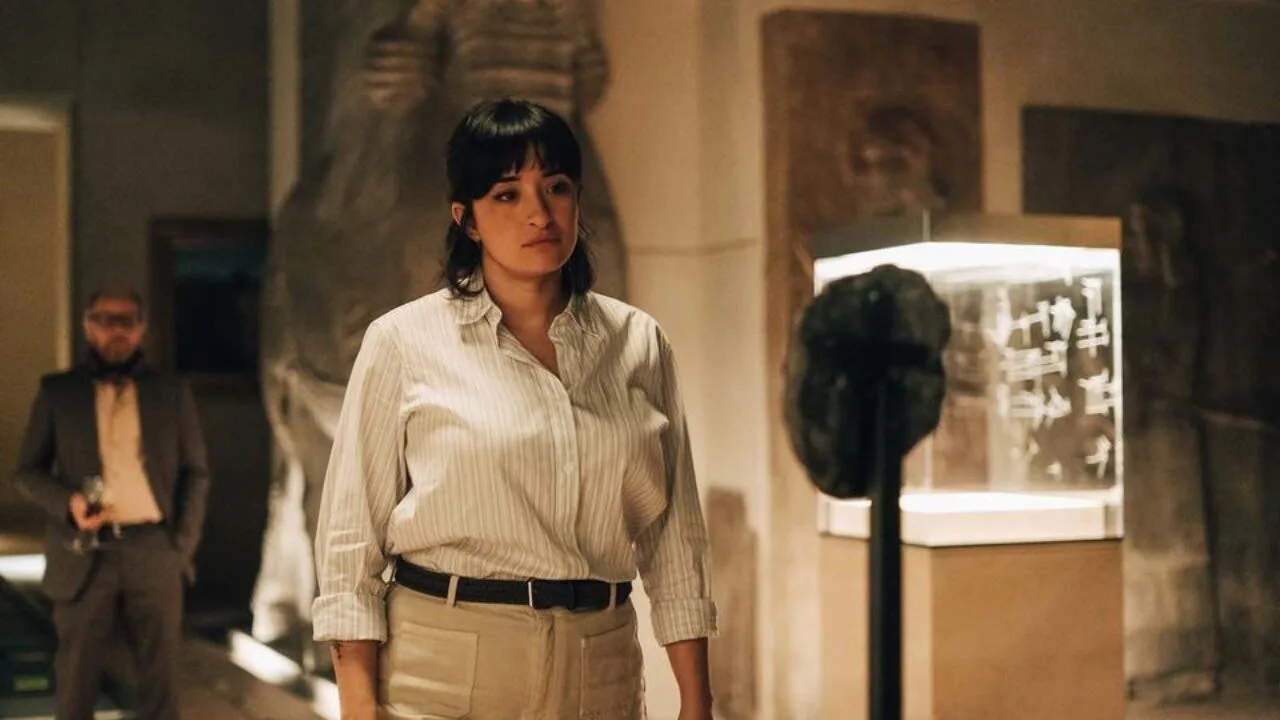
Created by Nils Antoine Sambuc and Thomas Mansuy, with writing by Mathieu Leblanc alongside them, the series follows Hafsa Moreau, an art conservator hired to work at the Louvre. Played by Shirine Boutella, Hafsa is brought in as a specialist—someone used to bringing fragile objects back to life.
Her assignment takes a dark turn when she comes across a mysterious Mesopotamian mask depicting Baal Phégor, a storm deity whose name has sometimes been merged over time into “Belphégor.” From that discovery forward, the show begins to blur the boundaries between ancient myth, institutional secrets, and Hafsa’s own psychological fault lines.
From Discovery to Downward Spiral
Once the mask enters Hafsa’s life, strange events escalate quickly. People linked to the artifact begin to disappear under unexplained circumstances, and Hafsa starts to experience blackouts and memory gaps she can’t account for. As the episodes unfold:
- She becomes the prime suspect in an unfolding investigation.
- Her missing memories make it impossible for her—or the audience—to fully trust what she says or sees.
- The show constantly asks whether she’s being manipulated, haunted, or unraveling under the weight of past trauma.
Rather than functioning as a simple whodunit, the story weaves together two threads: a crime investigation and an intimate dive into a mind under extreme pressure. The tension comes as much from what might be buried in Hafsa’s past as from any external threat. The mask is not just a cursed object; it’s a mirror that forces the heroine to confront who she is and what she’s trying not to remember.
A Strong French Ensemble Cast Anchors the Story
To ground the show’s more psychological and supernatural elements, Belphégor leans on a cast of well-known French actors, several of whom should be familiar to international viewers who follow European cinema and TV:
- Shirine Boutella takes on the demanding lead role of Hafsa Moreau.
- Vincent Elbaz appears in a key supporting role that intersects closely with the investigation.
- Aure Atika brings a sharp edge to the institutional and personal power dynamics around Hafsa.
- Tiphaine Daviot adds tension as a character whose loyalties and motives aren’t immediately clear.
- Nicolas Briançon represents one of the faces of authority Hafsa must navigate.
- Kad Merad plays Hafsa’s father, a presence that becomes crucial as the show explores her history and emotional scars.
Pathé, the French studio behind the series, positions Belphégor as a mainstream thriller that still has the budget, visual ambition, and narrative density to compete with other international HBO Max originals. The Louvre itself—and the museum-adjacent spaces recreated or used on location—serve as a visual signature, marrying the prestige of world-famous art with the dark intimacy of a psychological thriller.
Global Ambitions: How Belphégor Was Built for an International Audience
Belphégor isn’t just a local French curiosity dropping quietly onto a U.S. streaming menu. It’s designed from the ground up as a cross-border production. Pathé, M6, and HBO Max are all on board as co-producers, giving the show both a strong French identity and a clear international pathway.
Here’s how the rollout is structured:
- HBO Max premiere: December 11, 2025, as a global-facing launch on the platform.
- French broadcast: A subsequent 2026 run on the free-to-air channel M6.
The series was filmed from March to May 2025 in Paris and across the Île-de-France region under the direction of Jérémy Mainguy. Before reaching a wider audience, it debuted at the Festival de la fiction de La Rochelle 2025 in the “Event Fictions” category—an early signal that Pathé is using the project as a calling card for its new, dedicated TV drama division.
From Classic Novel to Contemporary Psychological Horror
The show is adapted from the novel by Arthur Bernède, but it treats the source material more like a springboard than a sacred text. Over the decades, Belphégor has gone through multiple incarnations in France, each reshaping how audiences perceive the myth—especially the 1965 TV series that associated the name with a spectral figure haunting museum corridors.
The 2025 series, though, pivots firmly into psychological thriller territory. Instead of focusing on the question “Who is Belphégor?” as a masked or ghostly presence, the new version asks something more intimate and unsettling: What does this mask unlock inside Hafsa, and why?
The story constantly balances three possible explanations for the events onscreen:
- Genuine supernatural influence tied to the Mesopotamian artifact.
- Deliberate human manipulation using the legend as cover.
- Psychic fractures rooted in personal trauma and memory.
That deliberate ambiguity is what brings the show in line with current psychological horror trends popular with U.S. audiences, where the scariest part is often not a monster in the dark, but the possibility that the danger is coming from inside the protagonist’s own mind.
A Compact Four-Episode Format With High Stakes
Belphégor is built as a limited series of 4 episodes, each 52 minutes long. For viewers used to U.S. miniseries and true-event dramatizations, that means there’s no sprawling multi-season commitment—just a single, self-contained storyline designed to be binged over a weekend.
This tighter format matches HBO Max’s broader approach to “event thrillers”: keep the episode count low, maintain a high level of narrative intensity, and let the story reach a definitive conclusion rather than stretching it across several seasons. The result is a focused arc centered on Hafsa, the mask, and a compressed timeline where every episode pushes the mystery toward its resolution.
Quick Facts: What to Know Before You Stream Belphégor
Title: Belphégor
Genre: Psychological thriller
Creators: Nils Antoine Sambuc, Thomas Mansuy
Writers: Nils Antoine Sambuc, Thomas Mansuy, Mathieu Leblanc
Director: Jérémy Mainguy
Producers: Pathé – M6 – HBO Max
Lead producer: Aude Albano
Format: 4 × 52-minute episodes (limited series)
Main cast: Shirine Boutella, Vincent Elbaz, Aure Atika, Tiphaine Daviot, Nicolas Briançon, Kad Merad
Shooting period: March–May 2025 in Paris and the Île-de-France region
Streaming premiere: December 11, 2025 on HBO Max
French TV broadcast: 2026 on M6
Is Belphégor Worth Adding to Your HBO Max Watchlist?
If you’re into shows that mix art, history, and psychological tension—think of titles where museums, archives, or artifacts become central to the plot—Belphégor should land squarely in your queue. The Louvre setting offers instant visual appeal, while the limited run makes it an easy commitment compared to long-running crime series.
For U.S. viewers specifically, the series also functions as a window into how France revisits its own pop-cultural myths. You don’t need to know anything about the earlier iterations of Belphégor to follow the story; this version is designed as a fresh entry point. But if you do enjoy tracking how iconic characters and legends evolve across decades and formats, this adaptation adds another layer to a long-running conversation in French genre storytelling.
FAQ
What is Belphégor about in this new HBO Max version?
The 2025 Belphégor series follows Hafsa Moreau, an art restorer working at the Louvre who discovers an ancient Mesopotamian mask linked to the deity Baal Phégor. After she finds the mask, unexplained disappearances and gaps in her memory pull her into a tense investigation that blurs the line between supernatural forces, human manipulation, and her own buried trauma.
Do I need to know the older Belphégor stories to enjoy the show?
No. While the series is based on Arthur Bernède’s novel and nods to earlier French adaptations, it’s intentionally structured as a standalone psychological thriller. New viewers can jump in without any prior knowledge, and longtime fans will simply recognize how this version reinterprets familiar elements.
How many episodes does Belphégor have, and where can I watch it in the U.S.?
Belphégor is a limited series with 4 episodes, each running about 52 minutes. In the United States and other HBO Max territories, it premieres on December 11, 2025. In France, the series will later air on the free-to-air channel M6 in 2026.
Is Belphégor more horror or more crime thriller?
The show leans more toward psychological thriller than pure horror. It uses horror elements—like the cursed-object tension around the mask and the unsettling museum setting—to explore paranoia, identity, and repressed memories. Viewers who enjoy slow-burn suspense and ambiguous, character-driven mysteries will likely find it a better fit than those looking for nonstop jump scares.