
Warning: This article contains MAJOR spoilers for Stranger Things season 5 part 2 on Netflix.
Released on December 26 on Netflix, Stranger Things season 5 part 2 pushes the mythology of the series further than ever. Vecna’s master plan comes into focus, the Upside Down finally gets a clearer explanation, and several character arcs reach emotional turning points. Yet the show deliberately stops short of giving us a definitive conclusion before the final episode of the series.
Stranger Things Season 5 Part 2 Recap: What Actually Happens?
Instead of wrapping everything up neatly, part 2 essentially resets the chessboard for one last, decisive confrontation. The Hawkins crew learns the true nature of the Upside Down, unravels what Vecna has really been building since Henry Creel was first exiled, and designs a high-risk plan that demands brutal sacrifices — even if no one dies just yet.
On a character level, the season makes time for long-teased reveals (especially for Will), breaks up one of the show’s core couples, and hints that Eleven herself may be the key not only to saving the world, but to ending the cycle that created kids like her in the first place.
The Upside Down Reframed: A Dimensional Bridge, Not a Full World
Season 5 part 2 radically reframes what fans thought they knew about the Upside Down. Thanks to Dustin’s deductions, the group realizes the Upside Down isn’t a fully independent parallel universe. Instead, it functions as an interdimensional corridor that connects Hawkins to a deeper, more hostile space known as the Abyss.
This changes the stakes completely. Vecna isn’t just trying to leak monsters into Indiana; he’s attempting to force a merger between the human world and the Abyss itself. The Upside Down is merely the tunnel — the construction site where his plan is taking shape.
- The Upside Down operates as a tunnel rather than a self-contained reality
- The Abyss is the dimension where Eleven originally banished Henry Creel
- Vecna’s endgame is a full-scale fusion of the Abyss with our world, triggering global collapse
The season draws a direct parallel to A Wrinkle in Time, which Holly Wheeler is seen reading. Vecna presents himself as someone trying to avert an even greater darkness by “reshaping” existence — a justification that echoes the twisted, cosmic morality seen in the novel, but weaponized for his own purposes.
Vecna’s Endgame: Twelve Children and a Twisted “Salvation”
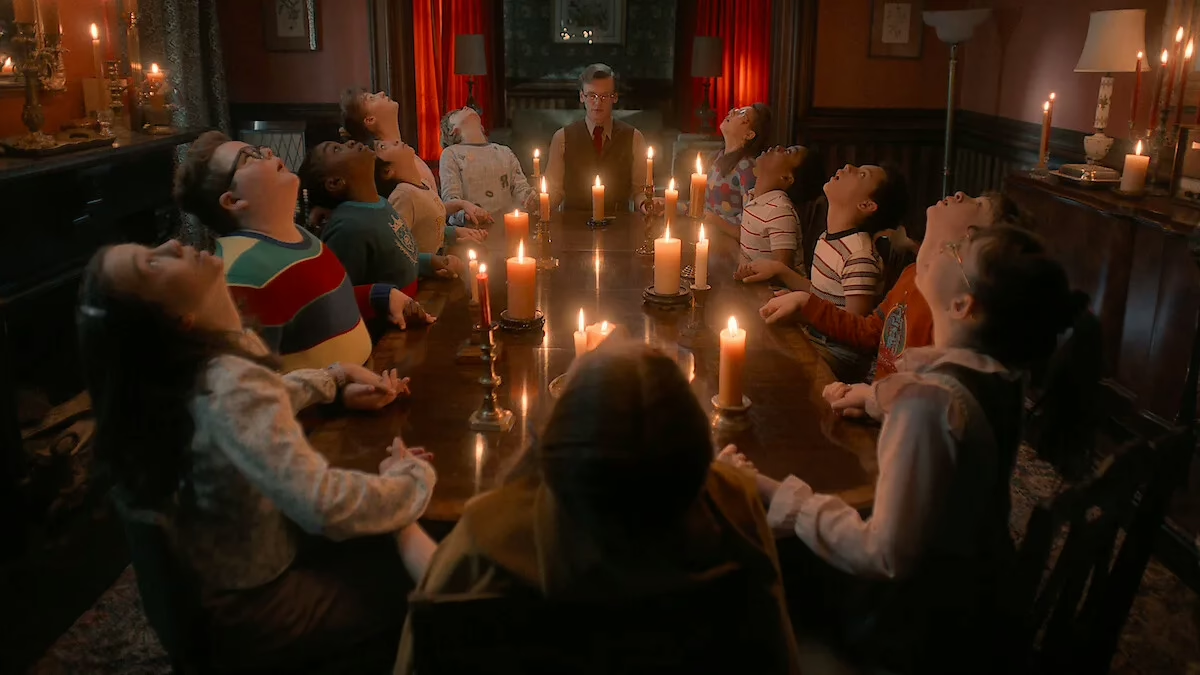
Henry Creel finally lays out his worldview in full. His plan centers on twelve children, whose powers he wants to convert into a massive energy source capable of rewriting reality. In his mind, humanity is already on a collision course with a greater, unseen darkness, and his brutal strategy is the only way to “save” what’s left.
Holly becomes crucial here. While Max awakens from her coma and reunites with Lucas, Holly remains physically trapped in the Abyss, wired into Vecna’s device as one of the vital components for this energy network. Her captivity becomes both a moral line for the group and a practical obstacle: they can’t destroy everything without figuring out how — or if — she can be pulled out alive.
Exotic Matter: The Fragile Heart of the Upside Down
Midway through part 2, the characters uncover the structural weakness of the Upside Down: a spherical mass of exotic matter that keeps the interdimensional bridge stable. This sphere effectively anchors the tunnel between Hawkins and the Abyss.
When Nancy shoots the sphere, the effect is violent but incomplete. Instead of a clean shutdown, she triggers a partial collapse:
- Segments of Hawkins Lab begin to decay into a gray, amorphous substance
- Sections of the environment are pulled into the void
- The Upside Down destabilizes, but the exotic matter isn’t fully annihilated
This failed destruction becomes the key to the group’s final strategy. They realize they can weaponize this instability: allow the convergence of worlds to peak, use that moment to access the Abyss, free the captive children, and then obliterate the exotic matter once and for all. It’s a plan that involves precise timing and near-certain casualties if anything goes wrong.
Steve, Eleven and the Two-Front War Against Vecna
Part 2 divides the battle into two complementary fronts: a physical mission and a psychic one.
Steve steps into a surprisingly strategic role. Far from just the reluctant babysitter of earlier seasons, he becomes essential to coordinating the on-the-ground tactics that revolve around exploiting the exotic matter’s instability and navigating the collapsing environment.
Eleven, meanwhile, has to confront Vecna on what is effectively his home turf: the mental landscape shaped by the Abyss. Their clash is less about raw power than about control over reality’s underlying rules. The show leans heavily into psychological horror here, turning their psychic duel into a test of identity, trauma and free will.
Major Character Arcs: Resolutions Without Deaths
One of the biggest surprises in the back half of season 5 is what doesn’t happen: none of the main characters die in part 2. Instead, the emotional gut punches come from confessions, breakups and reckonings rather than shock kills.
Will’s Coming Out Finally Happens
After multiple seasons of subtext and hints, Will finally tells his loved ones about his sexuality. The moment lands as something the show has been carefully building toward — an overdue piece of honesty that redefines his relationships, particularly within the core friend group.
Nancy and Jonathan’s Relationship Ends
Nancy and Jonathan make a definitive decision to end their relationship. Rather than a dramatic blow-up, their breakup feels inevitable, a recognition that their lives have evolved in different directions and that clinging to an old version of themselves would only hold them back.
Dustin and Steve Make Peace Over Eddie
The lingering tension between Dustin and Steve over Eddie’s death finally comes to a head. Part 2 gives them the space to address their guilt, anger and grief, leading to a reconciliation that restores one of the show’s most beloved dynamics.
Eleven’s Future: The Most Dangerous Choice Still Ahead
Even with all these developments, the biggest unresolved question centers on Eleven. Kali returns with a chilling observation: as long as Eleven is alive, her blood can be used to produce more children with abilities like hers. In other words, the very existence of Eleven — and what was done to her — contains the blueprint for repeating the Hawkins Lab nightmare endlessly.
This raises an unthinkable possibility: could Eleven choose to remain inside the Upside Down (or the Abyss) during the final explosion in order to break the cycle forever? Part 2 deliberately refuses to answer. Instead, it frames this as the ultimate moral dilemma awaiting the final episode:
- Save the world, but risk the system that created kids like Eleven continuing elsewhere
- Or make a sacrifice so extreme that the cycle can never be repeated
The season ends on that knife’s edge, with the story pausing just before anyone commits to the most radical solution on the table.
Is the Upside Down Gone at the End of Part 2?
By the final moments of part 2, the Upside Down is in chaos but not erased. The exotic matter sphere has been damaged, the environment is tearing itself apart, and Hawkins Lab is half-consumed by a gray, collapsing substance. Yet because the core energy source wasn’t fully destroyed, the bridge between worlds still exists — unstable, but functional enough for Vecna’s plan to remain possible.
This limbo state is exactly what sets up the stakes for the last episode: the characters have one final shot to exploit the weakened state of the Upside Down while preventing Vecna from stabilizing or redirecting its power.
Why Season 5 Part 2 Stops Where It Does
From a storytelling perspective, ending part 2 where it does is intentional. The show clarifies the mechanics of the Upside Down, spells out Vecna’s objectives, untangles several long-running subplots, and then halts right before forcing its characters to make irreversible choices. It’s a structural cliffhanger: the setup is complete, but the moral and physical cost of the endgame hasn’t been paid yet.
For US audiences tuning in during the holiday season, this release strategy also keeps Stranger Things firmly in the pop culture conversation, giving fans weeks of speculation about whether Eleven will survive, what it means to destroy the exotic matter, and whether the show will dare to end on a bittersweet or tragic note.
Key Takeaways From Stranger Things Season 5 Part 2
- The Upside Down is a dimensional bridge, not a standalone universe
- The Abyss is the true source of Vecna’s power and the destination of his planned world-merger
- Exotic matter keeps the bridge stable; damaging it destabilizes but doesn’t erase the Upside Down
- Will comes out, Nancy and Jonathan split, and Dustin and Steve reconcile
- Holly is trapped in the Abyss and wired into Vecna’s device
- No main character dies in part 2, but Eleven may face a self-sacrificial choice in the finale
FAQ
Are there any major character deaths in Stranger Things season 5 part 2?
No. Despite intense battles and high stakes, all the main characters make it out of part 2 alive. The emotional impact comes more from tough decisions, reveals and relationship shifts than from surprise deaths.
Is the Upside Down completely destroyed by the end of part 2?
No. The Upside Down is heavily destabilized after Nancy damages the exotic matter sphere, but the energy source isn’t fully destroyed. As a result, the interdimensional bridge still exists, giving Vecna one last chance to complete his plan — and the heroes one final opportunity to stop him.
What is Vecna’s real plan with the Abyss and the twelve children?
Vecna intends to harness the power of twelve children as a massive energy battery to fuse the human world with the Abyss. He claims this will prevent an even larger cosmic darkness from consuming reality, but the method involves catastrophic destruction and the total remaking of existence on his terms.
Is Eleven destined to die in the Stranger Things series finale?
Part 2 does not answer this. Kali suggests that as long as Eleven lives, her blood can be used to create more powered children, implying that a permanent solution might require an extreme sacrifice. The show leaves this possibility open, setting up the finale to decide whether Eleven survives, chooses to stay behind, or finds a third way to end the cycle.